Projects & Methods
Summary of published findings
Diesel exhaust particles (DEP) are the major environmental driver of asthma, implicated in asthma inception, severity and exacerbations. Pregnancy cohort studies suggest that DEP effects on asthma may span across generations. Intrigued by these association studies, we used a mouse model to uncover a causal relationship between maternal exposure to DEP and asthma susceptibility in offspring (PMIDs: 28943469, 24365139, 32407293). We then showed that asthma predisposition in this model was linked to overproduction of pro-inflammatory cytokines IL1 beta and IL17A (Pathway 1; PMID: 28943469), and activation of natural killer (NK) cells (Pathway 2; PMIDs: 24365139, 32407293).
NK cells are normally cytotoxic, express the type-1 immunity cytokine IFN gamma and participate in anti-viral and anti-tumor responses. Maternal DEP reprogrammed offspring NK cells, leading to upregulation of GATA3, IL5 and IL13. GATA3 is the master transcription factor for typ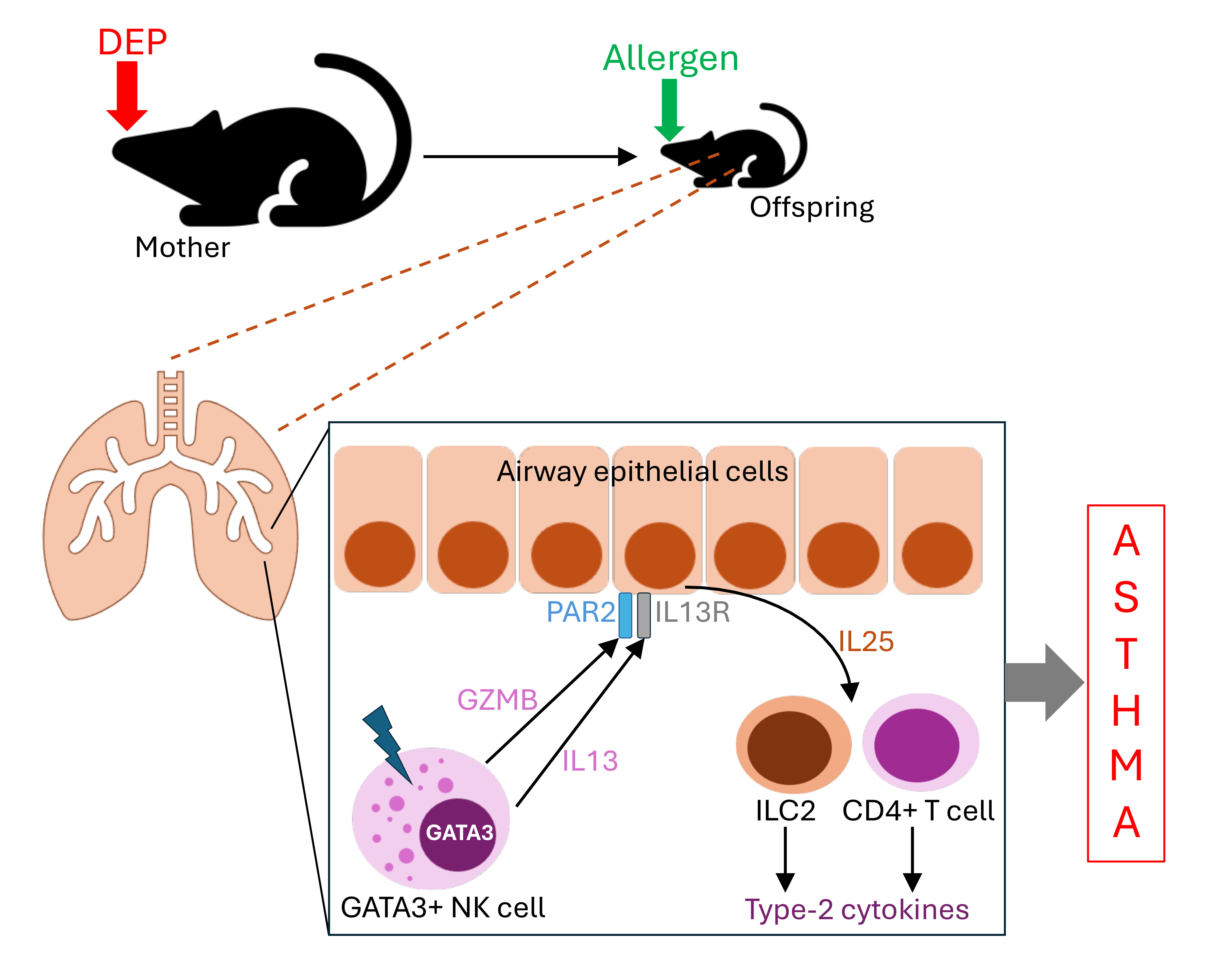 e 2 immunity, and crucial for production of type 2 cytokines, development and pro-allergic functions of innate and adaptive lymphocytes, including ILC2s and Th2 cells. GATA3 induction in NK cells signified an acquisition of allergic identity. In allergen-challenged pups of DEP-exposed mothers, GATA3+ NK cells co-secreted type-2 cytokines and the ‘killer’ protease granzyme B into the lung extracellular space. NK cell-derived granzyme B and type-2 cytokines worked together in the induction of eosinophilic inflammation and asthma. In contrast to intracellular granzyme B, which cleaves cytoplasmic caspases to induce cell death, extracellular granzyme B did not kill but rather cleaved and stimulated protease-activated receptor 2 (PAR2) on the surface of airway epithelial cells. Additional stimulatory signal was generated by NK cell-derived IL13. Simultaneous activation of epithelial PAR2 and IL13R promoted gene transcription and release of IL25. Epithelial IL25 activated group 2 innate lymphoid cells (ILC2s) and Th2 cells, leading to eosinophilic inflammation and asthma.
Finally, our studies suggested that DEP might induce an identical pathway in humans. Incubation of cord blood mononuclear cells with DEP led to NK cell degranulation (i.e. release of granzyme B into extracellular space) and NK cell production of type-2 cytokines. DEP had no effect on NK cell production of IFN gamma. A common allergen, house dust mite did not stimulate cord blood NK cells to degranulate and produce cytokines, indicating that allergens alone are not sufficient to elicit NK cell activation, and confirming our results in mouse models of asthma, in which NK cells had no role if exposure to an allergen was not linked to exposure to DEP. Further, our results suggested that human NK cell products had capacity to induce asthma via mechanisms similar to those elicited by products of mouse NK cells. As such, in the in vitro experiments, recombinant human granzyme B induced transcription of the IL25 gene in human primary airway epithelial cells. The effect of human granzyme B on IL25 was enhanced by IL13, suggesting that IL13-granzyme B synergism exists in humans as well.
Together, our unexpected findings expanded functions of NK cells and granzyme B beyond cytotoxicity and anti-viral/anti-tumor responses, uncovering their roles as regulators of type-2 immunity and asthma.
Current Projects
- Maternal carriers of allergic information.
- Maternal effects on development of allergic immunity cells.
- Maternal effects on immune cell-stromal cell interactions in the lung.
- Early-life drivers of allergic immunity in humans.
Methods
- Immunology
- Mouse models of allergic diseases
- Immune cell isolation and adoptive transfers
- Bone marrow chimeras
- Spectral and conventional multi-color flow cytometry
- Tetramer assay
- Pulmonary science
- Lung function testing in mice (FlexiVent)
- Lung organoids
- Embryology
- Embryonic organ harvest
- Molecular biology
- Molecular cloning
- Recombinant retrovirus production, and primary cell infection
- Signaling, chromatin, and cell biology
- Transcription factor assays
- Signaling molecule assays
- Confocal microscopy
- Genetically-modified mice
- Genomics
- Bulk and single cell RNA-seq
- ATAC-seq